
Finding Rochester Residents Through Records
No single public household list exists for Rochester. The residents directory, in practice, is a chain of records kept by different custodians. A parcel record links an address to an assessed owner. A recorded deed places a name inside a transfer. An old library directory can settle a family-history question. It puts a household at an address decades back. Each answer has its own scope. Pick the source that fits the question rather than forcing one list to do everything.
Match the record to the task. A current property question starts with a city or county property record. A recorded transaction calls for the Clerk's index. A family-history search leans on Rochester Public Library directories, newspapers, maps, and cemetery indexes. The state's self-service voter tool serves only a registrant. It checks personal election status, not a street browse. Checked in sequence, these sources make any Rochester resident lookup far more reliable than any single roll.
- Search the address in the county or city property interface and save the parcel identifier, situs address, and sale reference.
- Use the sale book and page or party name in the Clerk's recorded-land index, then confirm the document type and legal description.
- For an older household, locate the address in the RPL house-directory or city-directory material and cross-check the surname.
- Check newspapers, cemetery resources, or court records only when their date and subject fit the question.
- Ask the responsible office for a record that is not online, using the documented counter, mail, phone, or request route.
Rochester Resident Record Custodians
Three local offices anchor most Rochester resident-record searches. The Monroe County Clerk records land instruments and handles court-clerk duties as well. Monroe County Real Property Tax Services maintains the assessment and tax-map material for 21 jurisdictions. The city property interface layers on Rochester-specific assessment, water, sale, zoning, code, and nuisance tabs. None of them is a roster of every person at an address, but each documents the relationship that office actually tracks.
Monroe County Clerk
39 W Main Street, Room 101
Rochester, NY 14614
585-753-1600
Monroe County RPTS
304 County Office Building
39 W Main Street, Rochester, NY
585-753-1125
Monroe County Board of Elections
County elections office
Rochester, New York
Use the office contact route
Street-by-street parcel work belongs on the Rochester street directory. Keep the address trail there separate from any one-person verification.
Rochester Parcel Records Start With Place
Two tools handle the first address-to-parcel step. They are the Monroe County RPTS property service and the City of Rochester property map. The city tool openly accepts Address, Owner, and SBL searches. Its results can pull property assessment and tax details, photos, water records, and the last sale. Zoning, code enforcement, nuisances, and tax exemptions appear too. The county record goes further. It adds the municipality or SWIS code, parcel ID, assessed values, class, and school district. Lot data, improvement details, sale data, and a source sync date round it out.
| City property field | Why it matters | Limit |
|---|---|---|
| Address, Owner, SBL | Starts a city parcel search | Does not establish every occupant |
| Last Sale | Can supply a date and book/page bridge | Not a complete title history |
| Zoning, code, water, tax tabs | Shows the city record layers tied to a parcel | Some updates can lag behind a change |
A Monroe County property-search view traces the assessment and tax path that anchors a Rochester address.
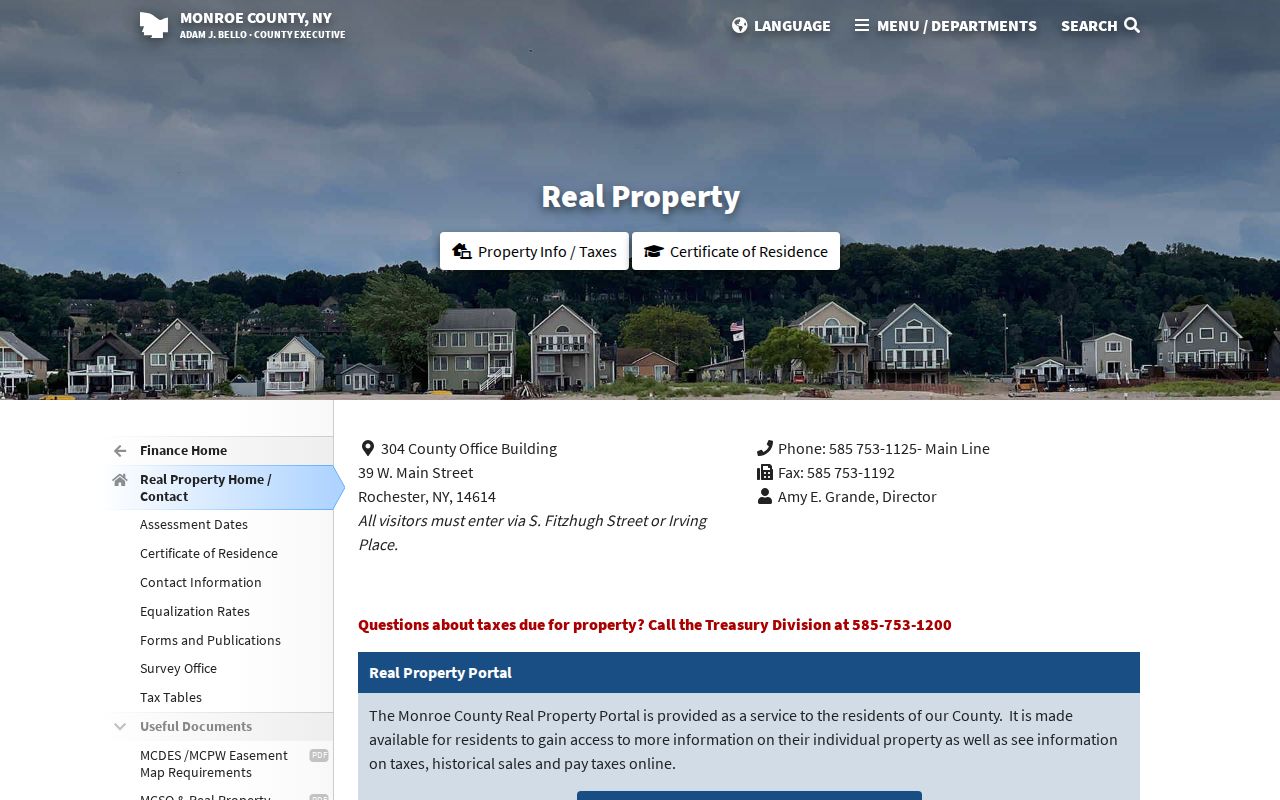
Treat the parcel card as an assessment and sales snapshot. A mailing address can differ from the physical, or situs, address. Neither one confirms a current residence on its own, so bring in another suitable record first.
- Parcel
- A mapped unit of property with an identifier used by assessment and GIS systems.
- Situs address
- The physical address attached to the parcel record.
- Index
- A finding tool that points to a record. It may not include an image of the record.
- Criss-cross directory
- A historical directory section arranged by address rather than surname.
Rochester Deed Records Add a Time Layer
The Monroe County SearchIQS index supplies the recorded-land layer of the Rochester residents directory. Published availability lists deeds indexed from August 28, 1973, with images from January 2, 1976. Older grantor-grantee books covering 1914–1975 and 1821–1907 remain index-only. Search with the parcel's sale reference, party spelling, instrument family, and legal description together. Remember the roles: a grantor conveys an interest, and a grantee receives it.
Access methods are tiered by the Clerk's current policy. Guest index search is free. Public terminals offer free image and index access. Remote document images require a subscription plus a per-page download or print charge. The counter, mail-copy route, telephone, and fax still work. Use them when an image or search control is unavailable online. Certified copies come from the Clerk, never from an index screen. Use the SearchIQS Monroe County land-record portal to reach the guest index and account controls.
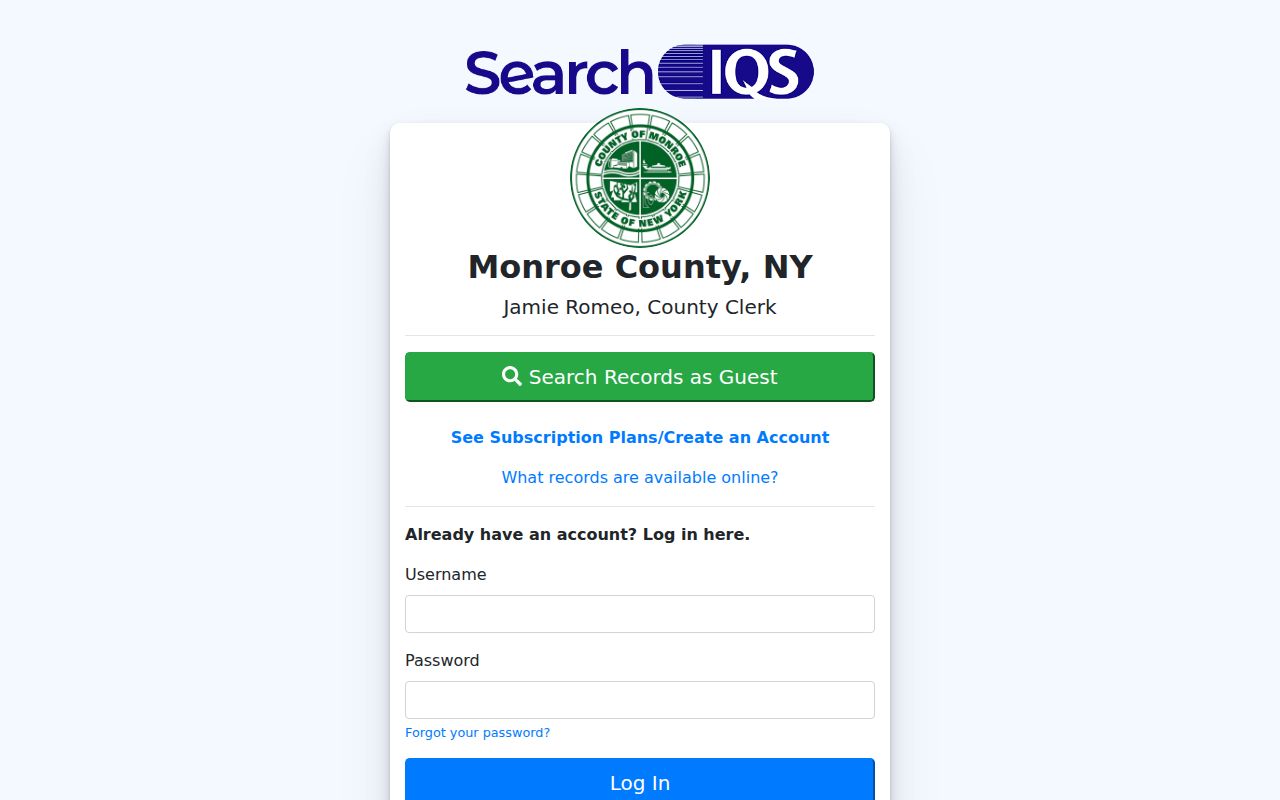
Before switching sources, write down the party name, document type, date, and index or book-page reference. The live query fields sit behind the Clerk's search form, so ask the Clerk for help with them. Note: The RPTS sale book and page is a useful bridge, but the recorded instrument is the source for the actual conveyance.
Rochester Voter Records Have a Narrow Role
New York's Voter Lookup exists for one purpose. It lets a registered voter check personal registration, poll-site, and mail-ballot details. Its controls ask for the person's name, date of birth, county, and address information. It does not turn the Rochester residents directory into a public voter list. There is no browsing by street or ZIP. A full voter file follows a separate request path under election-law use limits. The NYS Voter Lookup is a personal self-check route, not a neighborhood browse tool.
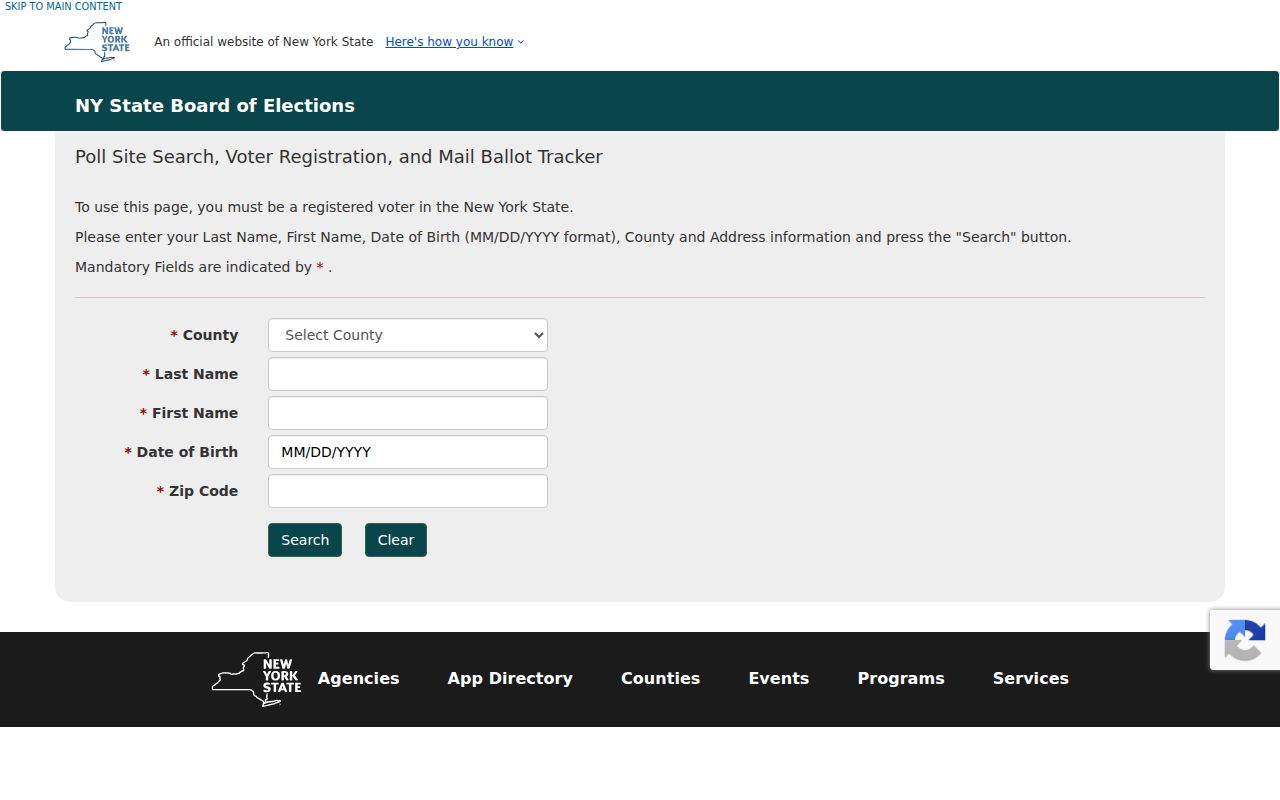
A missing public listing proves nothing. For a person who is protected or confidential, absence from a Rochester voter roll is not evidence of absence from the city. The state confidential-voter process and the Address Confidentiality Program shield some information from public view.
Current Rochester Resident Sources Compared
Current sources each answer a narrow question. The real test is not whether a source seems comprehensive but whether its keeper, date, and field type match your search. A property record supports an ownership or assessment connection. A deed index supports a party's recorded transaction. A self-lookup covers the registered person's own election check. RNeighbors and city association material identify community contacts, never households.
| Rochester source | What it can confirm | Keeper | Access route |
|---|---|---|---|
| Property assessment record | Parcel, assessed owner, sale references | RPTS or City Property | Public portal and office |
| Recorded-land index | Parties and instruments | Monroe County Clerk | Guest index, terminal, counter |
| Voter self-lookup | A registrant's own status and poll site | NYS elections system | Personal lookup only |
| Neighborhood associations | Community organization contact | Individual groups / RNeighbors | Public association routes |
Commercial people-finders are compiled databases, not record custodians. Entries can go stale, and similar names sometimes merge into one profile. The official Rochester trail moves slower. Its strength is transparency: you can see which office holds the record and when it was made.
Rochester Requests Reach Beyond Portals
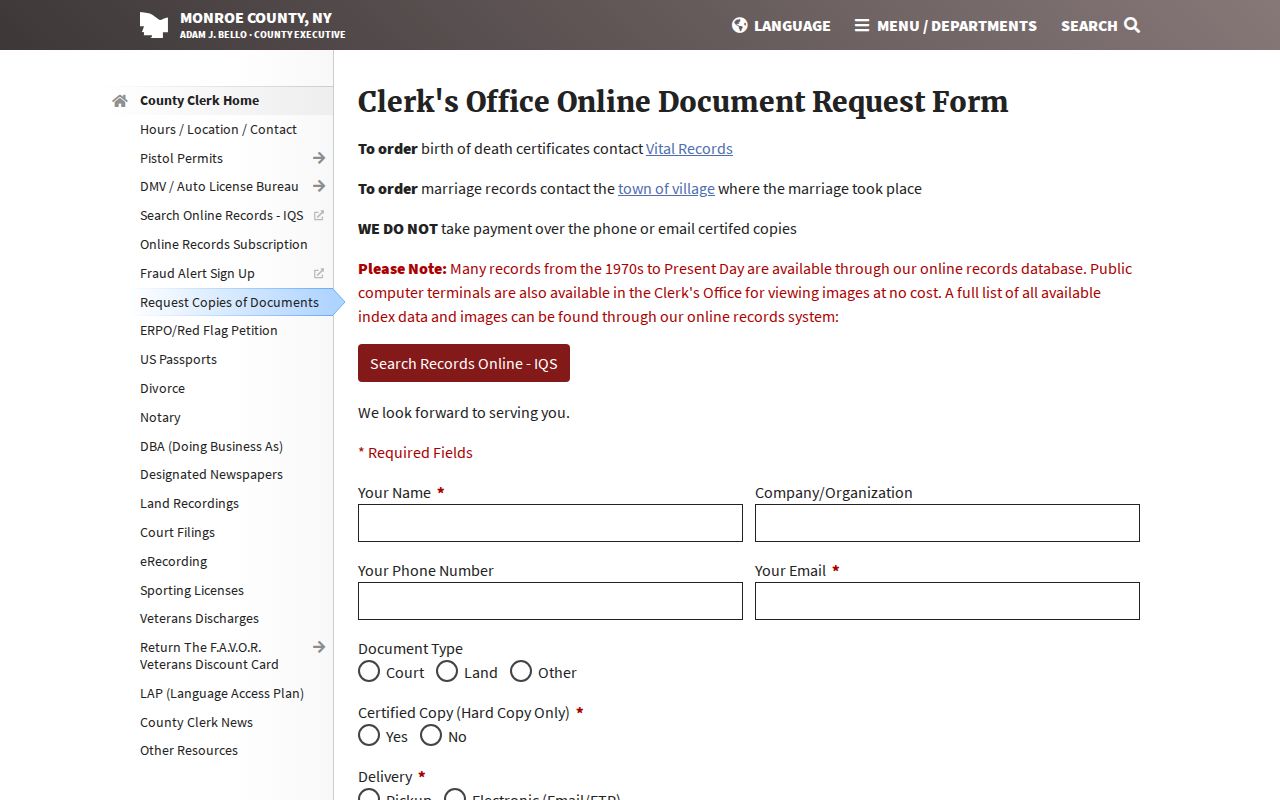
The Monroe County Clerk supports land-record searching and copies through several channels. Options include online, in person, by telephone, fax, and mail. Any request travels faster with the index number. Include the document type, the date, and a party name. The online order form splits requests into Court, Land, and Other categories. It redirects birth and death certificate requests to Vital Records. Marriage requests go to the issuing municipality. That form orders an existing document. It does not replace a vital-record application. The Monroe County online document order form shows the court, land, and other-document choices. A requester can pick from them.
New York's Freedom of Information Law sits in Public Officers Law Article 6. It spans sections 84 through 90. A FOIL request asks an agency to release an existing record. The record must be described well enough to find. It cannot override exemptions. Sealed files, vital records, protected voter data, and confidential addresses stay restricted regardless of the request.
Rochester Directory Collections Reach Back
Rochester Public Library's digitized city-directory collection starts with 1827 material and lists directories from 1827 through 1930, with selected volumes and gaps. The house-directory supplement is the address hunter's special route. It covers 1892 to 1920, while the main city directories carry an address or street section starting in 1922. One entry can yield a name, an address, a business line, a spouse or widow notation, or an occupancy mark where the printer included one. It cannot prove title, household relationships, or continuous residence.
Historical directories are a separate search task. The Rochester city directory page walks through the volumes, the reading conventions, and the household-by-year method without repeating the current parcel trail.
Rochester Street Changes Affect Resident Searches
Old Rochester addresses hide a local trap. Many streets were radically renumbered around 1884 to 1885 for consistency. The County Historian issues this warning plainly. The Municipal Archives street register spans 1834 to 1921. It logs street openings, dedications, and name changes. When an old directory number fails, keep the old spelling and number. Then compare the street register, historic maps, the parcel's legal description, and the modern GIS centerline.
A Rochester residents directory search should never read a failed address match as a failed name search. A later parcel may carry a different number. It may also show a renamed street, a merged lot, or a different city-versus-town jurisdiction. The local property interface updates nightly. Boundary and zoning layers can lag behind it.
Rochester Library and Cemetery Endpoints
Rochester Public Library Local History & Genealogy at Rundel Memorial Building holds city directories, yearbooks, genealogy indexes, maps, and licensed databases. It also keeps newspaper and microfilm runs. Its newspaper material includes an article index for 1818 to 1897. Life-record notices run roughly 1960 to 2016. Construction can limit access to collections. Staff suggest calling, emailing, or booking an appointment for deeper digging. Nothing circulates.
A directory or obituary name may have a later endpoint. That endpoint sits in the University of Rochester libraries' Mount Hope and Riverside Cemetery Interment Records index. The city cemetery page exposes no public name search. The university and library route is the documented research channel. County Historian and RPL Archives staff can help here. They can separate a Rochester city record from a similarly named Monroe community.
Rochester Privacy Limits Shape the Directory
Not every name-and-address link belongs in a public index. New York's Address Confidentiality Program falls under Executive Law section 108. It gives eligible participants a substitute address. Election Law section 5-508 adds a confidential-voter route. Sealed court files and restricted vital records each carry their own rules. DMV address data, private utility accounts, and protected election information carry their own rules too. A public parcel or deed record does not erase those limits.
Lawful personal research. Rochester records can support family history, heir work, civic questions, and property research. Do not use them to stalk, harass, intimidate, or harm any person.
Note: A missing result can reflect a source limit, a date gap, a protected record, or a different jurisdiction rather than a person's absence from the Rochester records. Keep that in mind before concluding a resident lookup came up empty.
Rochester Record Access Is Changing
Monroe County's April 1, 2026 land-record policy makes guest index searching free. Remote document images require a subscription under the same policy. Public terminals keep free access to both the index and the images. The Clerk also offers property-fraud alerts. The split matters when a resident-record search reaches a deed. An index reference may be viewable online. The image must be read at a terminal, through a subscription, or by ordered copy. The Clerk's subscription and fraud-alert policy documents the current index, image, and terminal arrangement.
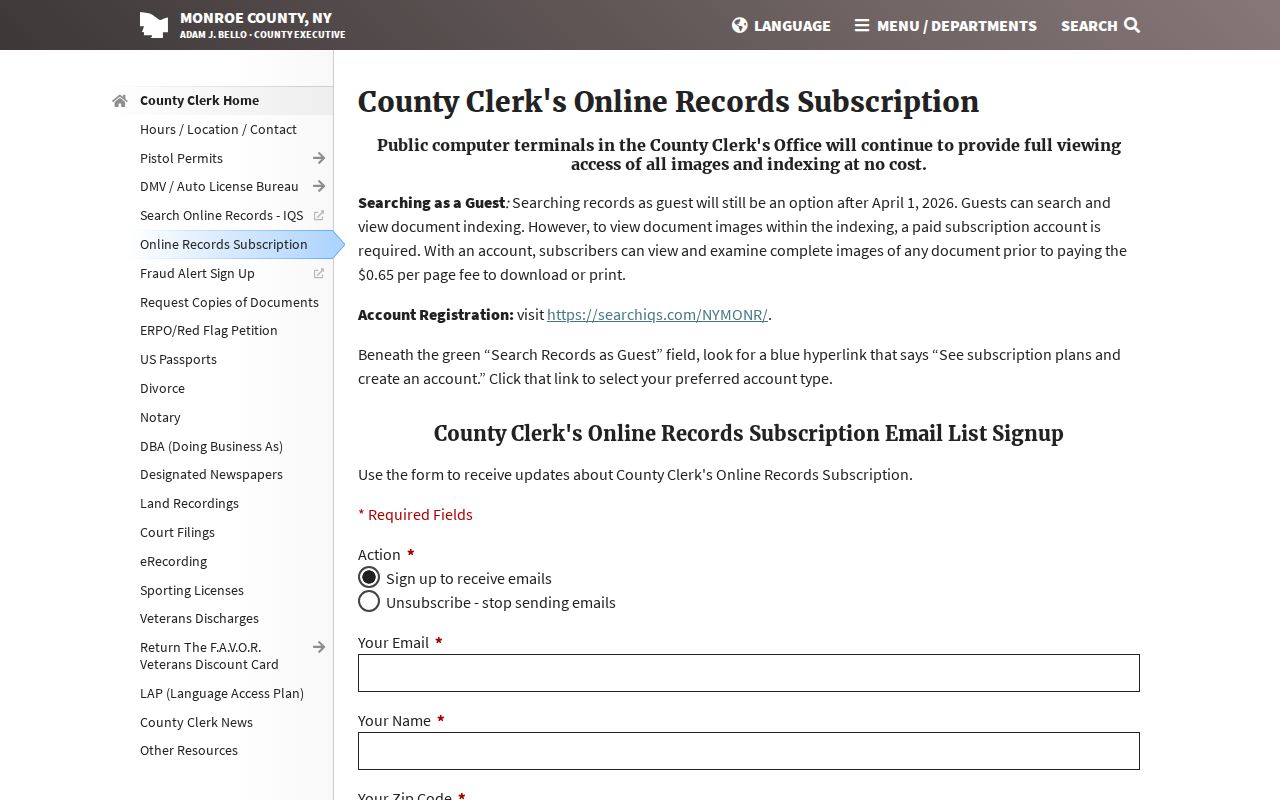
A 2025 to 2030 Monroe County digitization capital project names historical deed and grantor-grantee books, subdivision maps, and an online infodex as work in progress. Check the access date on any historical record. Keep the counter or library fallback ready when the item is not yet online.
Rochester Statewide Search Additions
Some resident questions point beyond county records. New York State's Office of the Professions runs a public license verification lookup. The Comptroller's unclaimed-funds route is a separate statewide name search. Neither one replaces a property, court, or vital-record custodian. Each is a narrow index that can surface a lead. Confirmation still comes from the agency holding the underlying record. The New York professional-license verification gateway is one statewide public index. It stays open to a Rochester searcher.
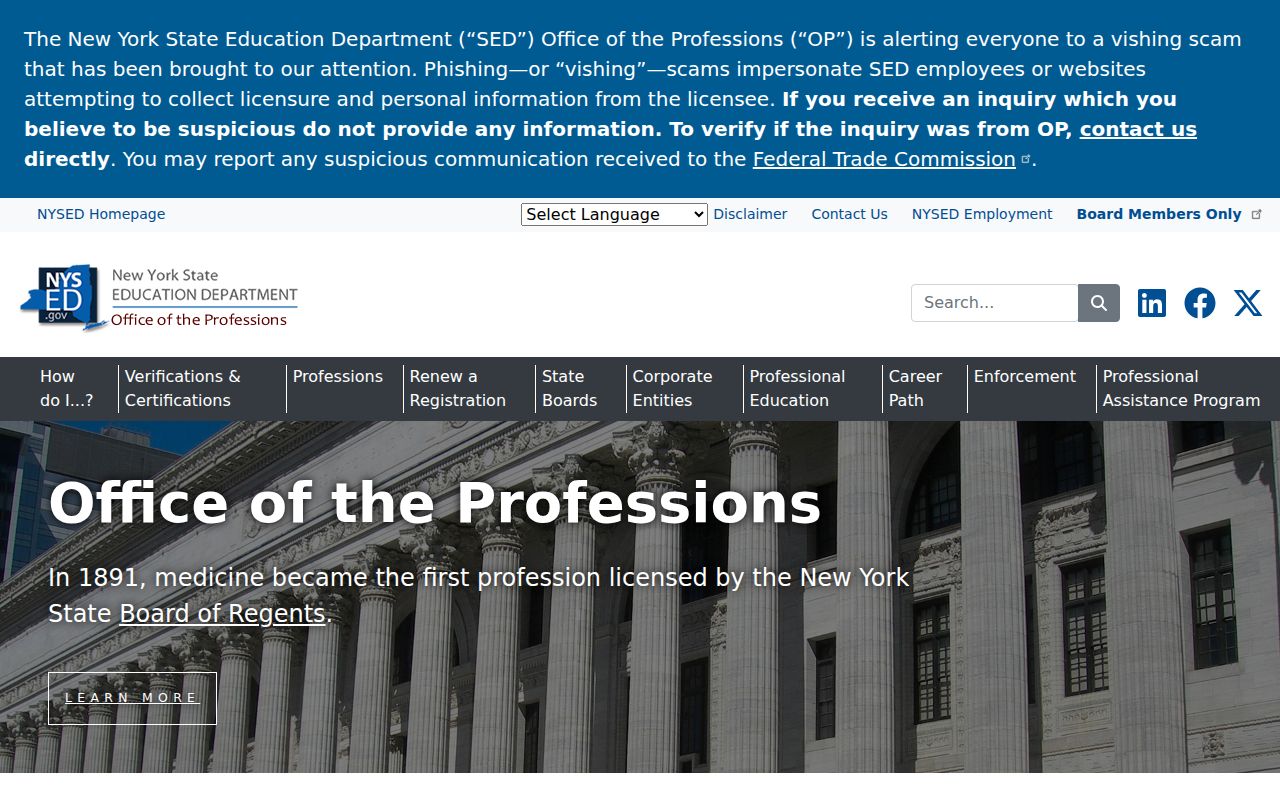
These results help tell a credential record apart from a residential one. They should never be used to infer a current address. The New York unclaimed-funds search route is another statewide lead, with its own status and claim requirements.
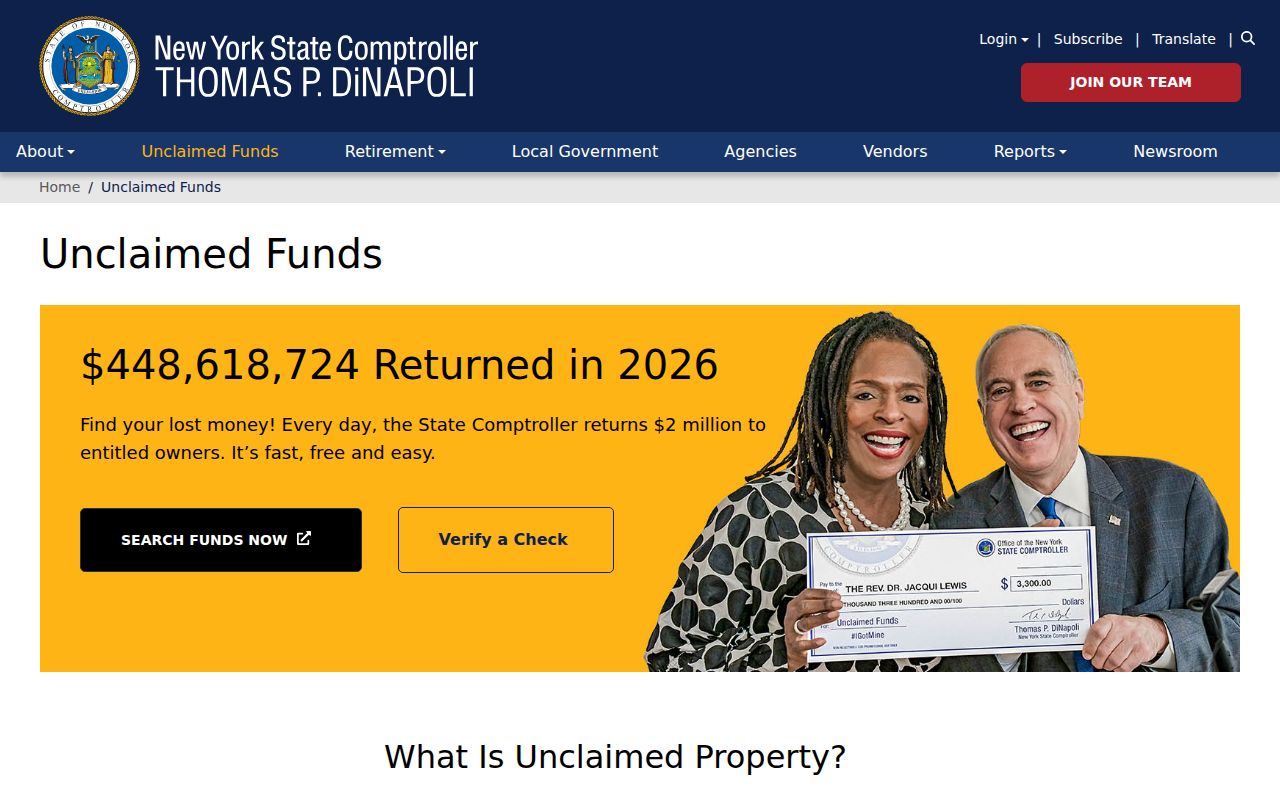
A name match is a lead, not a conclusion. Confirm it through the state office that holds the record before treating a Rochester residents directory result as proof of identity, residence, or entitlement.
Rochester Census Research Needs Local Fallbacks
Census research in Rochester depends on knowing what survived. The New York State census took its own counts between federal years. Many of them are gone. A 1911 fire at the State Capitol destroyed the state copies of the 1825 through 1905 schedules. County-clerk duplicates exist in some places and not others. Coverage is uneven by town and ward. The 1915 and 1925 schedules fared better. They sit at the State Archives, unindexed, which means page-by-page work. For anyone tracing a Rochester household, this history matters.