
Rochester Neighbors: Block Sources in One View
A Rochester block comes into view in layers. The parcel map draws where one lot ends and the next one begins. Assessment cards and deed books add an ownership interest and a recorded transfer. Old street directory volumes and city directory entries can leave a historical address clue. Community groups and service boundaries show where people organize or get help. None of that adds up to a roster of everyone on the block.
| Source | What It Shows About a Block | Access |
|---|---|---|
| Monroe County GIS Parcel Viewer | Adjoining parcel polygons, ZIP and boundary overlays, centerlines, streets and map layers | Public map browse, pan and parcel click |
| City property-information map | City parcel assessment, last-sale, zoning, code, water and related tabs | Public Address, Owner or SBL search |
| Monroe County RPTS | Assessment and sales-card details for a parcel | Public portal or report |
| Clerk / SearchIQS | Recorded parties and instruments for a specific parcel's deed trail | Guest index, public terminal, office or copy route |
| RPL house directories | Historical address occupants along a street | Library and digitized-volume routes |
| NYS Voter Lookup and BOE maps | A registrant's own status or election geography, not a block roster | Self-lookup and public district maps |
| RNeighbors and local associations | Community geography, public contacts, meetings and organizing context | Association page or contact route; no universal household list |
Be careful how far an owner name travels. An assessment card in Rochester names an ownership interest, not the person sleeping there. The situs address marks the parcel's physical spot. A tax mailing address may belong to a company, an agent, or a second correspondence location. Treat the two as different facts.
Rochester Neighbors Begin With Adjoining Parcels
Start on the map. Define the block from the actual adjoining parcel polygons. Then carry each parcel ID into the property and deed records. That method keeps every finding anchored to land you can see. It beats an assumed radius or any list of names pulled from thin air.
- Open the Monroe County Parcel Viewer, browse or zoom to the target parcel, and turn on the ZIP, boundary, or centerline layers when they help define the block.
- Click the target polygon and then each adjoining polygon. Preserve every parcel ID with the address as displayed and confirm whether the map is in Rochester or another Monroe municipality.
- Enter each parcel ID or address in RPTS or the city property map to separate the physical situs from a mailing route and to record the sale book/page where available.
- Use the book/page or party reference in SearchIQS for a recorded instrument. The deed can verify a conveyance, but it still does not identify every household member.
To follow one whole street instead of the block itself, use the Rochester street directory. That workflow walks the street from end to end. This one stays with the adjoining polygons around a starting parcel.
No Radius Tool Has Been Verified in the County Viewer
The county GIS viewer supports public map browsing, layer selection, panning, and parcel clicks. It offers no radius tool, buffer, export, or dedicated neighbors control. Click the adjoining polygons one at a time. The ZIP, town or village boundary, and centerline layers help frame the block, though postal geography is never the same thing as a city boundary. Rochester's service locator takes a different route, with address, Near Me, distance, and custom-polygon queries. It returns municipal services: districts, libraries, parks, fire stations, and neighborhood service centers. That is civic context, not an owner or resident roster. Note: Keep the parcel ID, municipality, source date, and map layer with each block finding so a similar address in a nearby town never gets folded into a Rochester result.
Rochester Neighbors: Read the Property Card Carefully
A Monroe RPTS card packs in the situs address, municipality or SWIS, parcel ID, assessment, property class, lot size, zoning, and building details. It also lists sale date and price, book and page, and a prior-owner reference. The city map adds tabs for assessment, tax, photos, water, last sale, and zoning. Code enforcement, nuisances, and exemptions get tabs too. Rich as that is, the card is not a current-occupant list or a final title determination. Match the address first. Then match the SBL or parcel ID. Match the municipality before you compare any names. A homestead or exemption flag is an assessment indicator and nothing more. A mailing address is correspondence information, not proof anyone lives at the situs. Rochester's city property-information page supplies the public address, owner, and SBL route behind this interface.
Once the parcel is pinned down, the property card can point toward a sale reference or a deed search. It cannot turn a map click into a claim about every resident nearby.
Rochester Neighbors and the Voter Record Boundary
The NYS Voter Lookup is a self-lookup for one registrant, not a browse-by-address directory. It asks for a last name, first name, date of birth, county, and ZIP or address details. It may return registration, poll-site, or ballot-tracker information. A non-match means to check with the Board of Elections. It does not mean that the person is unregistered. For block context, Monroe County Board of Elections district maps show election geography. Canvass material does too. A full voter-file request is separate. It must state an elections purpose under Election Law §3-103(5). Confidential voter records stay outside public inspection. So a neighborhood search should never present voter rolls as a complete list of who lives on a block.
Rochester Neighbors Can Use Community Contacts
Association names work as a geographic index. Think of them as a way to find a meeting or a contact route, not as proof that any particular person belongs. RNeighbors serves as an umbrella community resource for the city. City material, meanwhile, identifies groups and areas such as ABC Streets, Beechwood, Cobbs Hill, Highland Park, Lock 66, NOTA, North Winton Village, South Wedge, Swillburg, Upper Monroe, and Wadsworth Square. Always check an association's stated geography and date. Never assume its boundary tracks a ZIP code, ward, or parcel line.
To start a block club, the city route runs through the Neighborhood Service Centers. Those offices help Rochester residents find the right city contact. They support recruitment, walks, meet-and-greets, and other block activities.
Treat the service center as a civic contact route, not a shortcut to private resident information. A good block note records the association name and its stated area. It also records a public contact method, the meeting notice, and the date you checked. That keeps a community lead intact without turning an organization list into a claim about one household or its members.
NE Service Center
500 Norton
585-428-7660
Monday-Friday, 8-5
NW Service Center
400 Dewey
585-428-7620
Monday-Friday, 8-5
SE Service Center
320 N Goodman, Suite 209
585-428-7640
Monday-Friday, 8-5
SW Service Center
923 Genesee
585-428-7630
Monday-Friday, 8-5
Rochester Neighbors and the 2026 Block-Club Layer
The city's 2026 Neighbors in Action awardee material shows active community groups. Named organizations include the Maplewood Neighborhood Association, Beechwood Neighborhood Coalition, 19th Ward Community Association, Highland Park Neighborhood Association, North Winton Village Association, Corn Hill Neighbors Association, and South Wedge Community Gardens. Several block clubs appear as well. Treat these as current community-context leads. They are not a household directory or a residents directory of any kind.
RNeighbors' association directory is the source represented below. Use it to spot a public association route. Then follow that group's own contact form, meeting notice, or joining process.
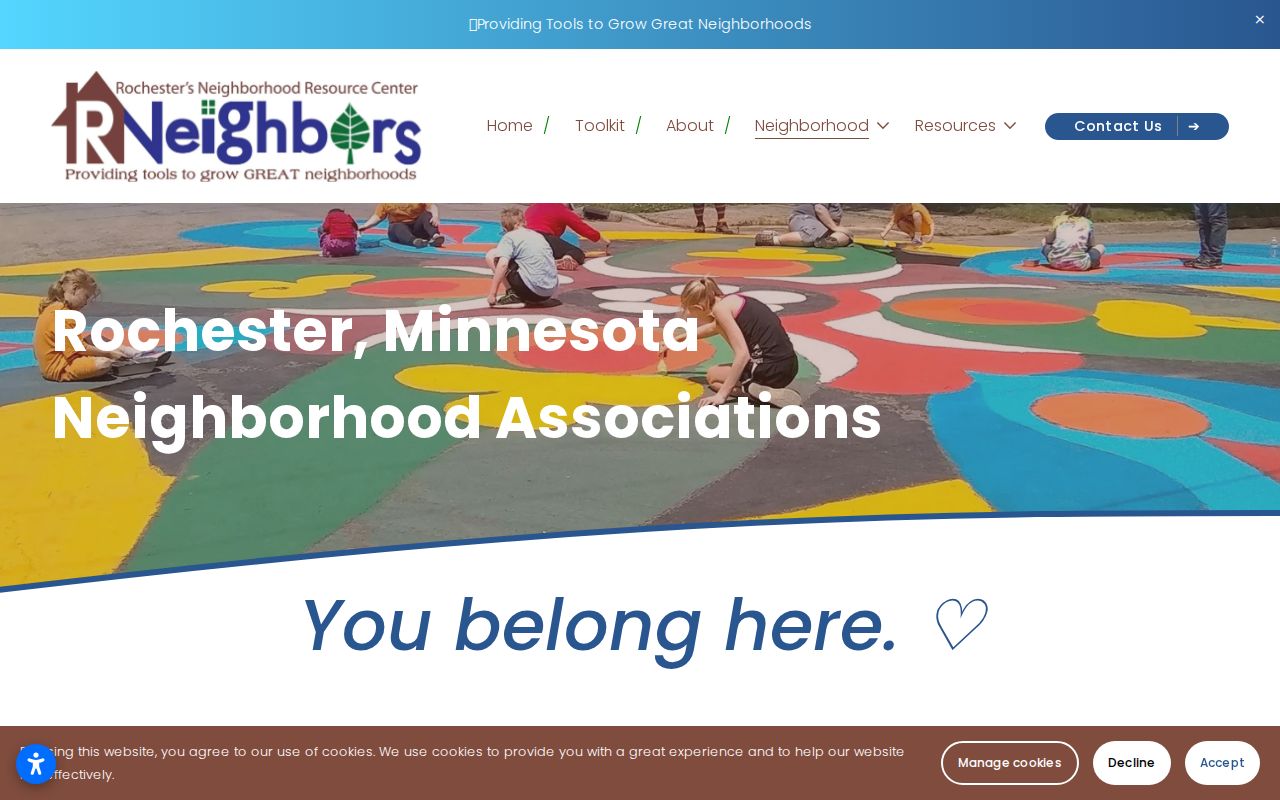
The directory helps you locate the organizing layer around a block in Rochester. It publishes no universal roster of the people who live there.
Rochester Neighbors: Official Records and Commercial Tools
Commercial neighbor-lookup tools are compiled data products, not government records. They can go stale, merge similar names, omit protected people, or tie a person to an outdated address. For a block question in Rochester, lean on official sources. Establish the parcel, the recorded instrument, historic address context, and public community contacts. Then state the remaining uncertainty plainly.
| Source type | Best for | Limit to keep in view |
|---|---|---|
| Official parcel, assessment, and deed records | Parcel boundaries, ownership interests, sale references, and recorded transfers | They do not list every person connected to a parcel or prove current occupancy. |
| Library directories and archives | Historic presence at an address, name variants, maps, and local chronology | Coverage has gaps and an entry is a dated clue, not a complete household finding. |
| Commercial compiled tools | A starting lead that may suggest an address connection | Accuracy, dates, source provenance, and protection status must be checked against the official record. |
Privacy Limits for Rochester Neighbor Research
A parcel map cannot reveal private utility customers. It also leaves out every household member, school attendance, private mailing lists, and any association's membership roll. New York's Address Confidentiality Program, under Executive Law §108, shields actual addresses for eligible participants. Confidential voter records under Election Law §5-508 are closed to public inspection and copying. Court sealing or redaction rules can also cut off a name or address trail.
The federal Driver's Privacy Protection Act guards DMV personal information. A public deed can still name parties. A related voter or court record may stay protected. This mix is exactly why Rochester neighbors research should carry a source label on every finding. Resist using a property record to infer private life details.
Lawful use. Use Rochester neighbor research for personal safety awareness, reconnecting, local history, and getting to know the block. Do not repeatedly contact, follow, threaten, surveil, or harass anyone; New York stalking and harassment laws apply.