
Rochester Previous Residents by Record Era
Rochester previous residents leave different kinds of evidence in different eras. A current assessment card can supply the parcel and sale reference, while the recorded instrument establishes a conveyance. Address directories and census schedules answer a separate question: who appears to have been at the address in a given year. The table keeps those sources in sequence so an old clue is not treated as proof of present title or household membership.
| Source | Years It Covers | Where Held | What It Shows |
|---|---|---|---|
| RPTS parcel and sales record | Current roll; sample synced in 2025 | Monroe County RPTS and city property map | Parcel identity, assessment details, sale date, book/page and prior owner clue |
| SearchIQS deed index | 08/28/1973 to present | Monroe County Clerk online guest index | Recorded deed parties, instrument/date and index reference; images begin 01/02/1976 |
| Grantor/grantee books | 1914-1975 and 1821-1907 | Clerk, public terminal or office route | Index-only bridge for a backward deed chain |
| Rochester house and city directories | House supplement 1892-1920; address section from 1922; selected runs from 1827 | Rochester Public Library | Address-to-occupant leads, spelling variants and household context |
| Street register and field cards | Street register 1834-1921; field cards 1927-1980 | City Archives | Numbering context, prior owner or resident clues, drawings and photographs |
| Federal and New York census | Federal 1790-1950; state census periodic 1825-1925 | NARA, library services, State Archives and possible county copies | Household and geography evidence, subject to survival and release limits |
Start with the parcel when the address is known. Start with the address section of a directory when the question is who lived here before. Then test names against the deed and census trail, preserving the source date beside every lead.
Start Rochester Previous Residents With One Parcel
Use Monroe County Real Property Tax Services or the City of Rochester property-information map to preserve the situs address exactly as displayed, along with the parcel ID, municipality or SWIS, tax-map reference, and sale book/page. That matters because a Rochester mailing address can point outside the city, and a tax mailing address may be a correspondence route rather than a home address.
The assessment card is a starting record, not a complete title report. Its sales history can expose a prior owner and book/page reference, but the recorded deed supplies the legal transfer. Capture both before moving backward, especially where a lot was later split or merged.
Monroe County RPTS property search is the source shown below, where the public property path leads from an address or parcel to assessment and sale details.
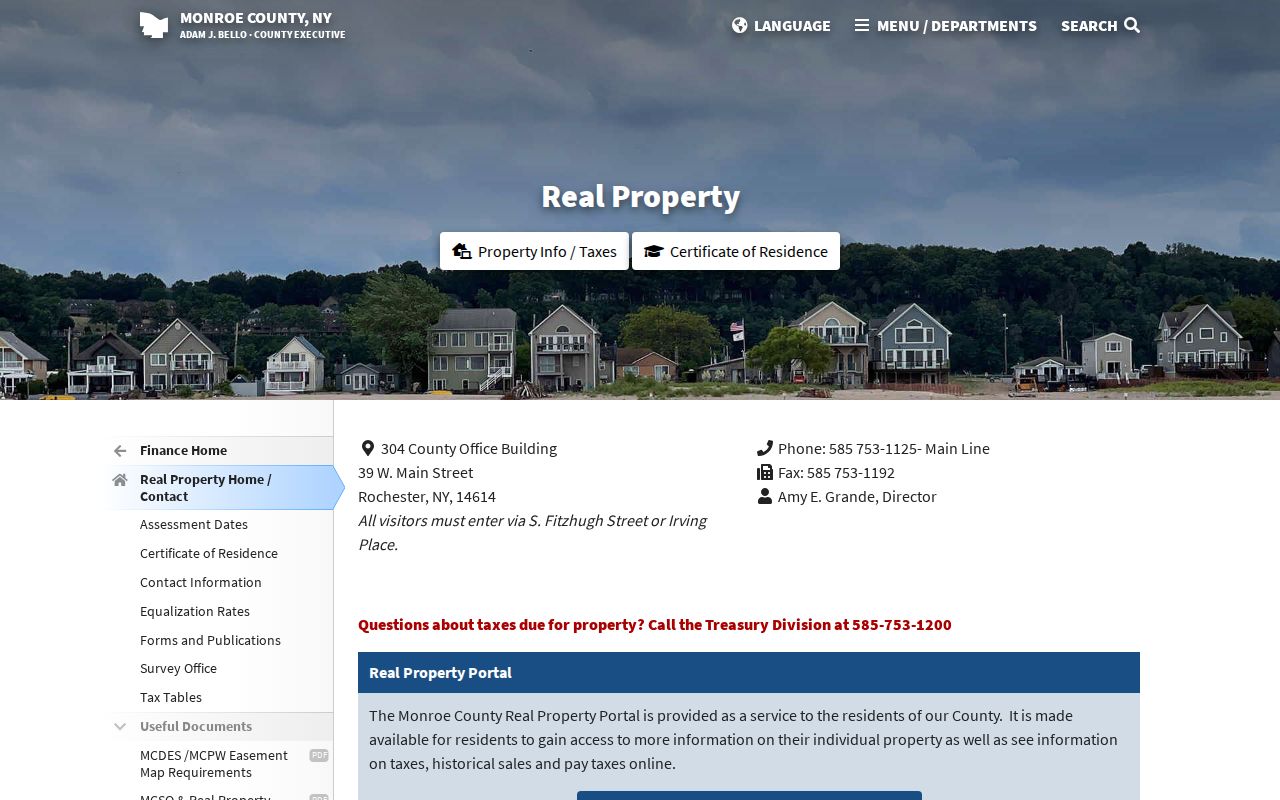
The result is useful for recording a parcel and a sale reference, while leaving the next question, who lived at the address, for the address-history sources that follow.
Rochester Previous Residents Through the Monroe County Deed Chain
The deed chain moves from a known current parcel to prior conveyances. In Monroe County, the practical bridge is the sale book/page on the RPTS card and the Monroe County SearchIQS land-record index. At each transfer, compare the legal description and tax parcel with the earlier document before deciding that two similarly named parties or addresses describe the same land.
- Save the current situs address, parcel ID, municipality or SWIS, and sales reference from the property record.
- Find the current grantee's purchase instrument in the Clerk index by the party or the recorded reference, then inspect the image at a public terminal, through subscription access, or by ordering a copy.
- Record the seller, buyer, recording date, instrument type, legal description, prior-deed reference, and parcel information from that instrument.
- Search that seller as an earlier grantee, checking that the legal description still follows the same property instead of relying on a modern street number alone.
- When the online sequence ends, move to the grantor/grantee books, Clerk microfilm, or an office request rather than filling a gap with a guessed owner.
- Grantor
- The seller or other party conveying an interest in a recorded instrument.
- Grantee
- The buyer or receiving party. A prior seller can often be found by searching that person as an earlier grantee.
- Chain of title
- The sequence of recorded transfers connected to the same parcel, checked document by document.
- Legal description
- The lot, block, tract, metes-and-bounds, or related land description in the record. It survives a street-name or number change more reliably than a modern address label.
SearchIQS and the 1973-to-1976 Online Split
SearchIQS is not one continuous online image collection. The published deed index starts on 08/28/1973, while deed images start on 01/02/1976. For older research, the 1914-1975 and 1821-1907 grantor/grantee books are index-only. A missing image online therefore does not establish that no deed exists, and an index result still needs its land description checked against the parcel.
As of April 1, 2026, guest users can search the index without charge, but online document images require a subscription. Public terminals keep free index and image access, and the Clerk remains a copy route. That distinction is especially important when tracing past residents through several transfers instead of stopping at a single result.
The Monroe County SearchIQS index is shown here with the guest-search and account paths that lead into the Clerk's land-record system.
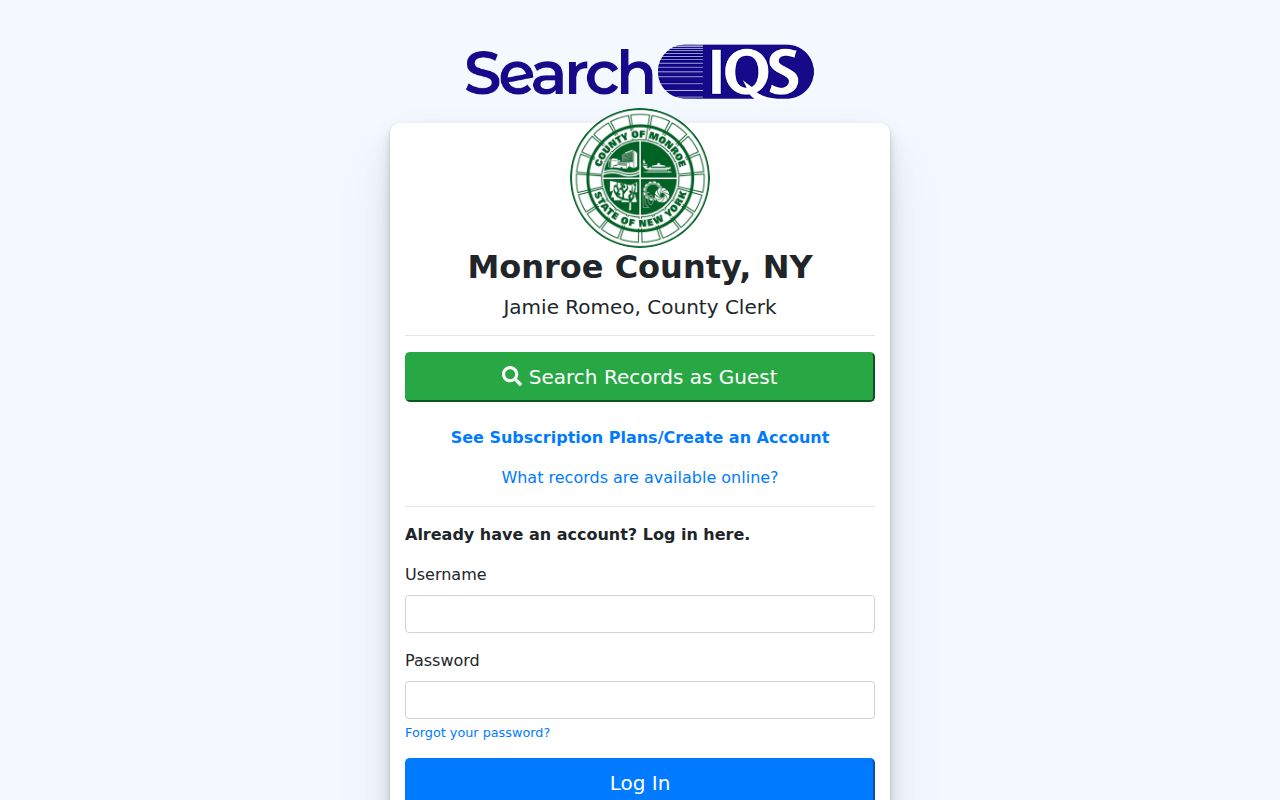
Use the screen as an index doorway, then keep a record of whether the next supporting item came from a guest index, a terminal image, a Clerk copy, or an older book.
Note: The Clerk's 2025-2030 digitization project includes historic deed and grantor-grantee books, subdivision maps, and online infodex work, but it does not promise that every earlier image is already online.
Rochester Previous Residents and the 1884-1885 Address Break
Rochester streets were radically renumbered for consistency around 1884-1885. An apparently missing household can therefore be an address-continuity problem, not a missing person. Compare the former and current street number, record old street names, and use the municipal street register to connect openings, name changes, and numbering context.
The legal description is the stronger bridge when a deed predates the current number. A plat, subdivision reference, tax map, GIS polygon, and nearby parcels can help translate lot and block language back to the modern parcel. The Monroe County Historian is a useful local route for the renumbering context and county history.
Rochester Previous Residents in Directory and Census Years
Ownership and residence are not interchangeable. Rochester's 1892-1920 house-directory supplement is organized for reverse, address-to-occupant work; the main city directory adds an address or street section beginning in 1922. The selected digitized directory run begins with 1827 material, but it has gaps, changing entry styles, and volumes that need their own title-page checks. The collections themselves are covered on the Rochester city directory page.
For past residents, read the address section and the surname section in the same year. Later entries can put a wife's name in parentheses and may identify adult children, while occupation, business address, widow notation, and owner or occupancy marks vary by volume. A directory entry is a dated presence clue, not a claim about legal title, family relationship, or continued residence.
- Write down the directory year, printed page or image number, street spelling, number, and every abbreviation used in the address entry.
- Check the alphabetical entry for the same person and year, then compare spouse, business, and notation details with the directory key.
- Repeat in nearby available volumes, allowing for spelling variants, city-boundary changes, annual gaps, and the numbering break.
- Pair the established address and ward or town geography with the appropriate federal or surviving New York census schedule. Federal schedules released through 1950 are available; state copies from 1825-1905 were largely lost in the 1911 State Capitol fire, while 1915 and 1925 originals remain at the State Archives without an index.
RPL newspapers provide another date check: the local runs begin in 1818, and life-record notices are available for roughly 1960-2016. Use a notice to find a lead, then return to the directory, deed, or probate record that can support it.
Maps, Field Cards, and the RPL House-History Worksheet
The Rochester Public Library's Searching Your House's History guide gives this research a local worksheet: former street name, plat or map year, tract and lot, directory year and address, owner, seller, buyer, permits, construction, architect, and utilities. It also directs researchers to the County Clerk, City Maps and Surveys, Municipal Archives, and the Landmark Society of Western New York.
FIMo Fire Insurance Maps Online covers 1875-1950 for in-library use. The city's historic map viewer uses separate municipal map years, so it should not be described as one continuous fire-insurance series. City Archives field assessment cards, dated 1927-1980, can add prior owner or resident clues plus drawings or photographs. Their appointment or archive-request route is part of the evidence, not a substitute for a deed.
Note: Preserve the map title, year, tract, lot, and source location, because a building clue may date an improvement without proving who lived there.
Rochester Previous Residents at the Trail's End
An obituary may identify a last address, spouse, parent, or survivor. Probate can identify heirs and estate representatives. RPL's newspaper index, local microfilm, University of Rochester and RPL cemetery resources, and the appropriate court or Clerk file each have different value. Treat the obituary as a lead and the probate, recorded instrument, or certificate as the record that supports a legal conclusion.
For very early land, Monroe County was created from Ontario and Genesee Counties in 1821. The Clerk's microfilm includes predecessor-county land transactions. That predecessor route explains a break before county creation more plausibly than assuming the Rochester parcel had no earlier record.
Lawful use. Rochester previous-resident research is for family history, estate work, property history, reconnection, and personal curiosity. Do not use a record to follow, threaten, surveil, or harass any living person; New York stalking and harassment laws apply.
Rochester Previous Residents Need a Dated Source Log
Keep the trail legible: label each finding as a directory lead, assessment or sales reference, recorded instrument, archive image, or court or vital record. Include the source date and a confidence note. If a deed uses tract, lot, or metes-and-bounds language, compare the plat, tax map, and adjoining parcels before assigning it to today's street number.
That log also makes a pause useful. A chain can stop because the instrument is older than the online index, filed in an index-only book, recorded in Ontario or Genesee County, entered under a spouse or entity variation, or tied to a parcel after subdivision. The next responsible step is a Clerk, microfilm, library, or archive route, not an invented connection.